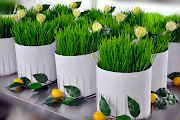
This is not going to be a lesson in composting (though that WILL be a topic in future postings) but rather a lesson in selecting high-quality packaged soil at a reasonable price to get you off the ground and running pretty quickly with your new wheatgrass growing venture.
Over my years of growing wheatgrass as a business, I have relied heavily on bagged soil for several reasons: 1) I initially did not have the amount of composted soil I needed to produce the amount of grass I was growing; 2) it was a convenient way for me to store and move soil from place to place as needed; and 3) it provided a practical solution to storing soil indoors during the frozen winter months.
When I first began growing wheatgrass for my own family, I would go to my nearest Lowe's or Home Depot and select their cheapest top soils. Sometimes the products were very clean (meaning free of debris); at other times, the very same packaged products were flat out disturbing. It became a bit of a roller coaster ride. I’d find bottle caps and glass fragments or even shredded plastic gloves. Sometimes the soils would be riddled with large stones (over a half-inch in diameter) or contain too many oversized sticks. Sometimes the anemic look of a soil alone was enough to tell me that it was not in good health. Visibly poor soil quality turned up in lower-end products about 50% of the time. Ultimately I decided it was just too hit-and-miss and not worth the upfront savings (and God only knows what those plastic gloves were used for!). The funny thing is that it had never occurred to me to rip open a bag—even an already damaged bag—and look at the soil before buying 10 more bags. That would have been too much like sampling a grape at the produce counter before buying the whole bunch. Right or wrong, it just doesn’t make sense NOT to!
It wasn’t until I began shopping around for my soil at smaller local hardware stores and talking to small business owners that I realized it was okay for me to sample the soil. Often, without my even asking, a seller would sense my concerns and rip open several bags for the sampling. I felt like a world-class chef scouring the souks of Northern Africa sampling mounds of spices to prepare exotic feasts. Over time, I developed a streamlined set of procedures for buying high-quality bagged soil.
1. PRODUCT LABELING. Examine the soil packaging carefully, and look for product labeling that specifically claims 100% organic content. Bottle caps, plastic gloves, and shards of glass are NOT acceptable and should not be found in bagged soil; therefore, do not even waste time sampling a bag that doesn’t claim to be 100% natural on the label.
2. COLOR. At very first sight, a soil’s color should appear dark and rich like coffee grounds. A soil that is rich in color is a soil that is rich in nutrients.

3. AROMA. Hold a handful of soil to your nose. Foul smelling soil means that it might still be composting and too “hot” for wheatgrass to grow optimally. A good soil should have a pleasant earthy aroma like the smell of spring air on a rainy day.
4. DEBRIS. Sift through a few handfuls of soil to check for synthetic and organic debris. Large stones (no more than ¼” diameter) and long sticks are not acceptable for the purpose of growing wheatgrass.
5. SOIL DENSITY. Soil should be light and crumbly when sifted through the fingers. A soil that does not break apart easily or is too fine-grained and compact should be an immediate indicator that soil amendments (such as mulch or peat moss) will be necessary to allow for soil aeration and promote healthy root growth. An easy way to check for soil density without even touching the soil is to look at how the bags stack together on a pallet. Bags that are unusually flat and uniform (like vacuum-packed coffee bricks) contain very dense soil. NOTE: Dense soil can trigger mold and promote root rot in your wheatgrass.
Once a bag of soil passes this first round of testing and you decide to buy several bags, be sure then that all of the bags you purchase come from the same pallet (usually there are 60 bags of soil per pallet). Soil does differ from shipment to shipment, and buying all of your bags from the same pallet will increase your chances of making a purchase consistent with the product you sampled.
Using these guidelines, there is no reason you should have to pay for expensive “designer label” top soil to grow a top-notch grass. Sometimes the cheapest bag of soil can turn out to be a diamond in the rough.
THE GROWER’S PICK: Jolly Gardener brand top soils (available only in the eastern and mid-western U.S.)
Always ask a store owner or department clerk before ripping open any salable product. If the store representative appears uncooperative, remind him that a larger sale is at stake and that he can always tape up the opening and put the product back on the shelf if you decide not to buy.
NEXT WEEK: Simple Soil Chemistry and Amendments


 Posts
Posts